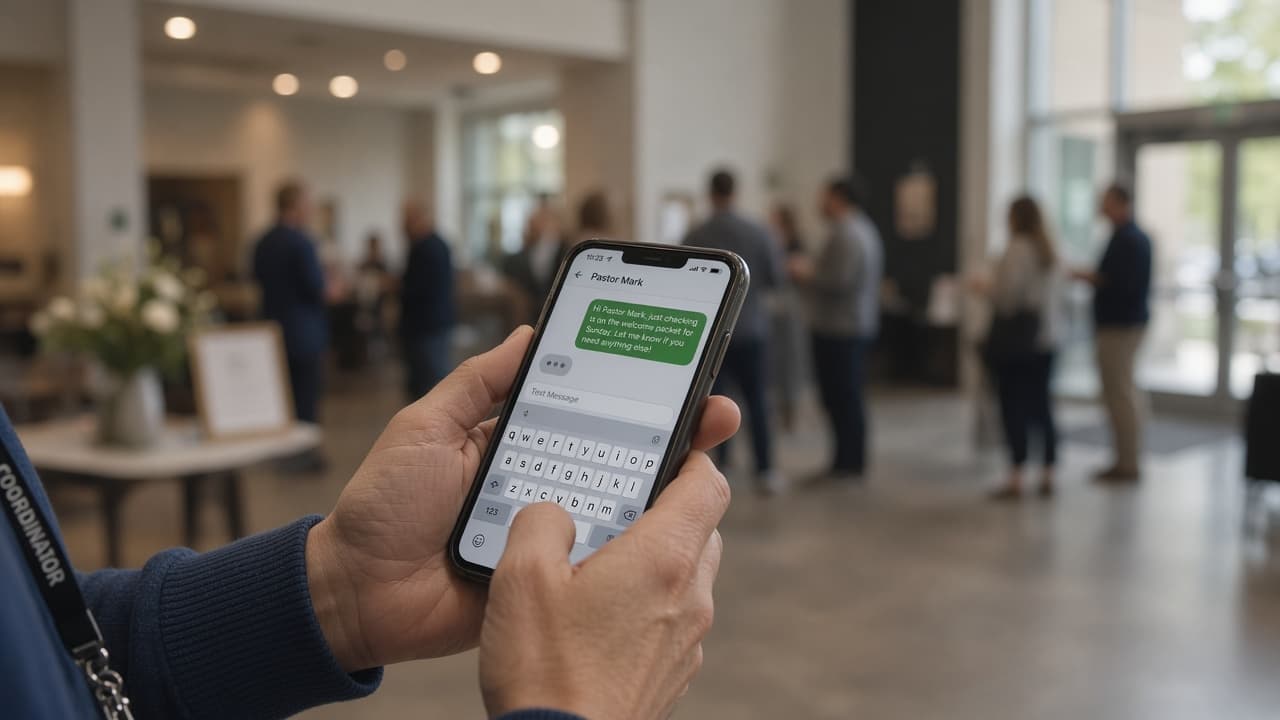
Poor communication is one of the five most common reasons church volunteers stop serving, according to practitioner research from ACS Technologies. It's not dramatic — it rarely involves a conflict or a bad experience. It's quieter than that: a volunteer who never got a clear schedule, or who found out about a change the morning it happened, or who sent a question and never heard back. Over time, that friction adds up. And eventually the volunteer stops wondering whether they're wanted, because they've decided the answer is no.
Separate the channels by urgency
Using email for everything, or a group chat for everything, or announcements from the stage for everything, creates a situation where volunteers can't tell what requires their immediate attention and what doesn't. Everything feels equally important, so nothing gets treated as urgent.
A cleaner approach: use text for time-sensitive communication (schedule reminders, day-of updates, urgent fill requests), email for detailed information that volunteers will want to reference later (role descriptions, monthly newsletters, event prep documents), and group announcements only for recognition and community-building — not for operational asks that require a response.
Text outperforms email for day-of coordination
99% of text messages are opened — and 90% are opened within three minutes of receipt, according to MissionWired's nonprofit benchmarks. Church emails see 35–45% open rates, which is actually above average for the sector. But for Sunday morning communication, that gap is decisive. A reminder that lands in an inbox at 7 AM may not be read until 9. A text is read before the volunteer gets out of the car.
This doesn't mean abandoning email. It means being deliberate: text for reminders and urgent requests, email for context and documentation. And for volunteers who've opted in to text, make sure what you send is genuinely useful — not just noise that trains them to ignore your messages. 1212 handles this cadence automatically — see the SMS platform for how quiet hours and per-person preferences work.
Build a communication calendar, not a response system
Programs that communicate reactively — only when something goes wrong or when a role needs filling — create a dynamic where volunteers associate hearing from you with bad news or urgency. That association makes volunteers less responsive over time, not more.
A proactive communication calendar looks like: schedule published two weeks out, reminder text five days before, day-of check-in message, thank-you text within 48 hours of service. That rhythm isn't complicated, but it requires someone to own it and execute it consistently. Consistency is what builds trust. Volunteers who trust that communication will come stop waiting to hear whether they're needed. The scheduling guide covers how to build the two-week timeline that makes this communication rhythm possible: church volunteer scheduling: a practical guide.
Make it easy for volunteers to communicate back
One-directional communication — coordinator to volunteer, no clear path the other direction — leaves volunteers without a way to flag problems, ask questions, or report they can't make it. The result is no-shows that could have been covered and problems that surface on Sunday morning instead of Thursday.
Every communication you send should have a clear response path. For scheduling, that means a confirmation mechanism: volunteers should know whether you expect a reply. For questions, it means a single point of contact with a response time you can actually commit to. For can't-makes-it, it means a clear process that doesn't require a phone call.
Treat the sub request like a personal ask, not a broadcast
When a role opens up and you need a fill, the instinct is to send a message to a large group and hope someone responds. Broadcast asks to groups almost always produce silence — everyone assumes someone else will respond, so no one does.
A personal direct message to one or two specific volunteers — 'Hey, we have an open slot in the welcome team this Sunday. Would you be able to help?' — will get a faster response and a higher yes rate than a group appeal every time. You may need to send three individual messages to find one yes. That's still faster than waiting for a volunteer to step up from a group blast.
Recognition is communication too
Most communication frameworks focus on operational messages — schedules, reminders, confirmations. But the messages that actually build a volunteer culture are the ones that have nothing to do with scheduling: the Tuesday text that says 'The way you handled the lobby backup on Sunday was exactly what we needed. Thank you.' The team email that calls out something specific a volunteer did well. The coordinator who remembers a detail from a conversation three weeks ago.
Volunteers who feel seen through communication are more responsive to operational messages. The relational investment pays operational dividends. These aren't two separate tracks — they're the same program. For twenty specific recognition ideas, most of them free: volunteer appreciation ideas that actually mean something.