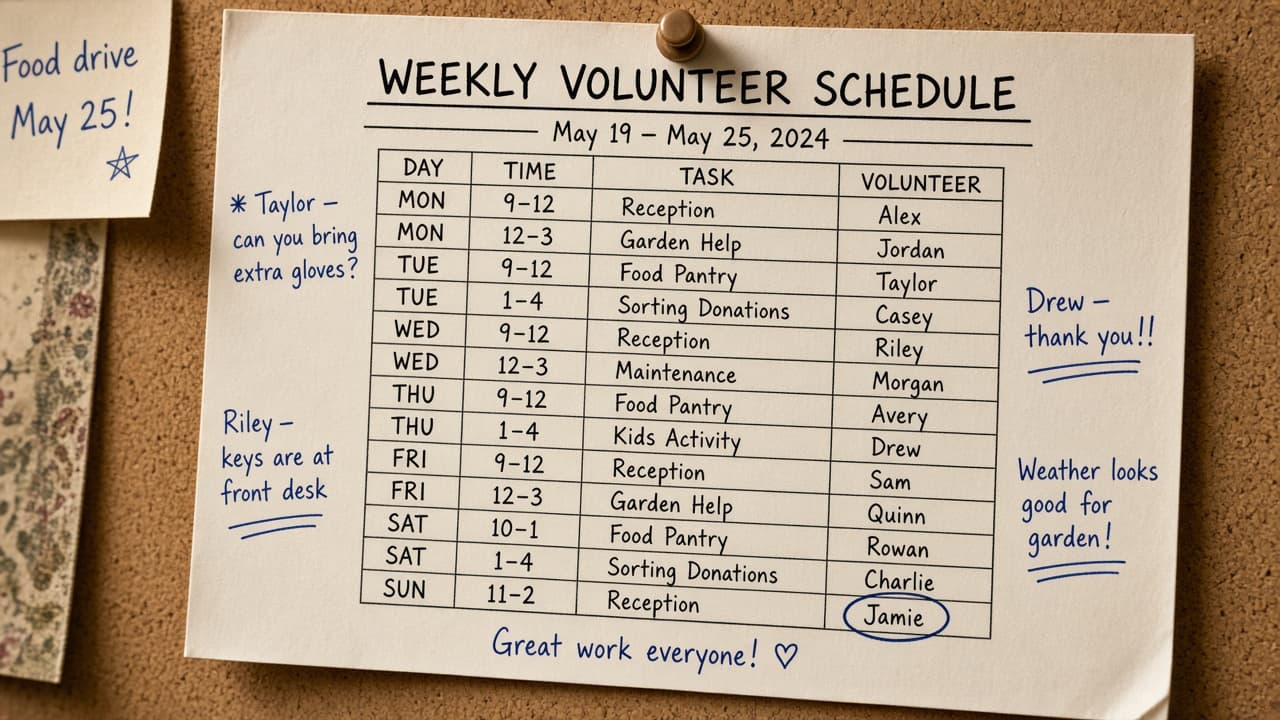
Church volunteer scheduling looks simple from the outside: put the right people in the right roles on the right Sundays. In practice, it involves tracking availability across dozens of people, managing rotating schedules, covering last-minute gaps, and doing all of it without making volunteers feel like numbers on a spreadsheet. The coordinators who do it well aren't using magic — they've built a system that handles the routine so they can focus on the relationships.
Collect availability before you build the schedule
The most common scheduling mistake is building the schedule first and then working backward to check if people are available. This produces a cascade of conflicts, followed by a scramble of individual outreach, followed by a patchwork schedule that nobody is fully confident in.
The cleaner approach: collect availability in a defined window — two to four weeks before the period you're scheduling — and build from that. It adds a step upfront but removes three steps of rework. For recurring schedules, collect seasonal availability (for example, each quarter) and only follow up for exceptions. Volunteers appreciate being asked in advance rather than informed at the last minute.
Design for rotation, not just coverage
A schedule that covers every slot doesn't necessarily serve your volunteers well. Volunteers who serve every single week without rotation are on a path to burnout — here's how to spot it early. Most church volunteers serve a couple of Sundays a month — not every week. Schedules built around that reality are more sustainable than ones that assume maximum availability.
A rotation schedule — where volunteers serve two or three Sundays a month rather than every week — also creates built-in redundancy. When someone can't make a given Sunday, the gap is smaller because you're not relying on any single person to anchor a role every week. It also frees up capacity to bring in new volunteers without immediately overloading the schedule.
Build a substitute bench before you need it
Every schedule will have gaps. Volunteers get sick. Emergencies happen. Life circumstances change. A program that handles no-shows gracefully isn't one where nobody ever misses — it's one where someone has a list of people who've agreed to be available for short-notice requests.
A working substitute bench has three components: names attached to specific roles (not just 'willing to help'), confirmed contact information, and a standing agreement that the person may get a same-day text occasionally. Five people on a sub list for children's ministry is worth more than any other contingency plan. And the investment is minimal: a five-minute conversation with five people who already want to serve. For the full no-show playbook, including what to say when you call a sub, see why volunteers don't show up on Sunday.
Publish schedules early and confirm them close
Volunteers who receive their schedule two weeks out have time to plan. Volunteers who find out the Thursday before are managing a surprise. The difference in no-show rates between those two experiences is real — and avoidable.
A practical timeline: publish the schedule 14 days out, send a confirmation or reminder 5 days before, follow up with a same-day text the morning of. That three-touch system is enough for most volunteers to stay oriented. For ministries with complex logistics — tech teams, worship support, children's ministry — building in a brief team huddle the week before can catch coordination problems before Sunday morning. For the full communication framework behind this, see church volunteer communication best practices.
Handle no-shows in person, not in a group chat
When a volunteer misses a shift without notice, the follow-up matters. A message to a group chat — 'Reminder: if you can't make your shift, please let us know in advance' — is perceived by everyone as directed at someone else. It teaches nobody anything and makes the people who already do communicate feel vaguely accused.
A direct, private conversation with the person who no-showed — not punitive, just curious — almost always surfaces something useful. Sometimes there was a genuine emergency. Sometimes there's a scheduling conflict that could be fixed. Sometimes the volunteer is quietly withdrawing and the conversation gives them a dignified off-ramp. None of those outcomes happen in a group message.
Let the schedule reflect your values, not just your gaps
Schedules built entirely around gap-filling end up looking like they were built that way — roles assigned to whoever was willing, not whoever was suited, with no visible logic about why someone is where they are. Volunteers notice. A person placed in a role that doesn't fit rarely asks why — they just quietly disengage.
The alternative is a schedule built first around fit and calling, then around coverage. It takes longer to build. It requires knowing your volunteers well enough to match them thoughtfully. But the result is a team that shows up because they're doing something they were made for, not something they got drafted into. There's a theological grounding for this in what 1 Corinthians 12 teaches us about volunteer ministry.