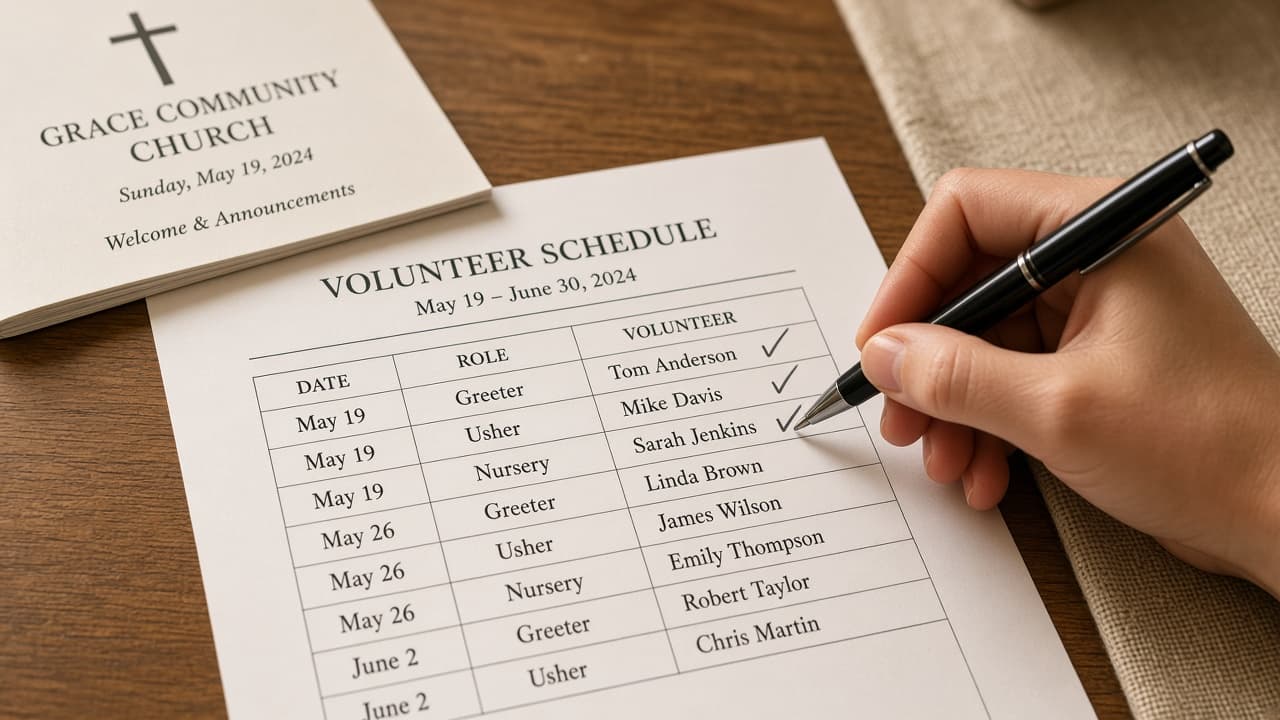
Sunday mornings don't have to feel like a fire drill. If your church still runs its volunteer program on a shared spreadsheet, you're spending hours every week on tasks you could automate. Here are seven things we wish every church coordinator knew before they started.
1. Build your roster two weeks out
Most no-shows and last-minute drops come from rosters that were finalized two days before Sunday. Two weeks gives people enough lead time to swap, ask for time off, or mentally prepare.
Set a recurring coordinator deadline (Wednesdays two weeks before) and protect it. For the full approach to building a roster that doesn't require constant rework, see church volunteer scheduling: a practical guide.
2. Capture service preferences at signup
Most volunteers have a clear preference — early service, late service, weekday-only. Capturing it once means you stop scheduling the wrong people.
Track it as a profile field and let the scheduler respect it automatically.
3. Stand up recurring assignments
Your most reliable volunteers want the same slot every week. Lock their assignment once and stop re-sending it.
Recurring assignments also expose gaps faster because the unfilled slots are obvious.
4. Automate reminders
Stop texting people manually. Email + SMS reminders at 7 days, 24 hours, and 2 hours close the gap between 'yeah I'm coming' and actually showing up.
Volunteers want the nudge — most would rather get a reminder than be left to remember on their own. The full communication framework — including how to write reminders that actually get responses — is in church volunteer communication best practices.
5. Build a substitute bench before you need it
Wait until someone calls in sick the night before and you'll panic every time. Keep a list of people willing to cover on short notice.
Tell every volunteer during onboarding: 'We may ask you to sub occasionally. Say yes when you can, say no when you can't.'
6. Track no-shows and act early
Two no-shows in a month is a pattern. Don't wait until someone stops showing up to have a conversation — reach out after the first one.
It's almost always a schedule conflict, exhaustion, or a miscommunication you can solve.
7. Let volunteers manage their own availability
When volunteers can update their own availability blockout dates, you stop assigning people to dates they can't serve.
This is built into 1212's volunteer self-service portal — volunteers manage their own blockout dates so the coordinator stops assigning people to Sundays they can't serve.
Frequently asked questions
How far in advance should churches schedule volunteers?
Two weeks out is the practical minimum. Most no-shows and last-minute drops trace back to rosters finalized two or three days before Sunday. Two weeks gives people time to swap, request time off, or flag a conflict before it becomes a Sunday morning emergency.
How do automated reminders reduce church volunteer no-shows?
Email and SMS reminders a week before, the day before, and the morning of the service close the gap between 'yeah I'm coming' and actually showing up. Most volunteers want the nudge — they'd rather receive a reminder than be left to remember on their own.
What is a volunteer substitute bench and how do you build one?
A substitute bench is a pre-identified list of volunteers willing to cover on short notice, organized by ministry area. Build it during onboarding by setting the expectation clearly: 'We may ask you to sub occasionally — say yes when you can, say no when you can't.' The bench only works if members know they're on it.
Why should churches let volunteers manage their own availability?
When volunteers can update their own blockout dates, coordinators stop assigning people to Sundays they can't serve. This is one of the highest-ROI features of any volunteer management system — it moves the data-collection burden to the person who actually has the information.
How do recurring volunteer assignments make scheduling easier?
Lock in your most reliable volunteers to the same slot every week and stop re-sending it. Recurring assignments also surface gaps faster because the unfilled slots stand out immediately, rather than hiding inside a roster that looks full until someone checks each name individually.